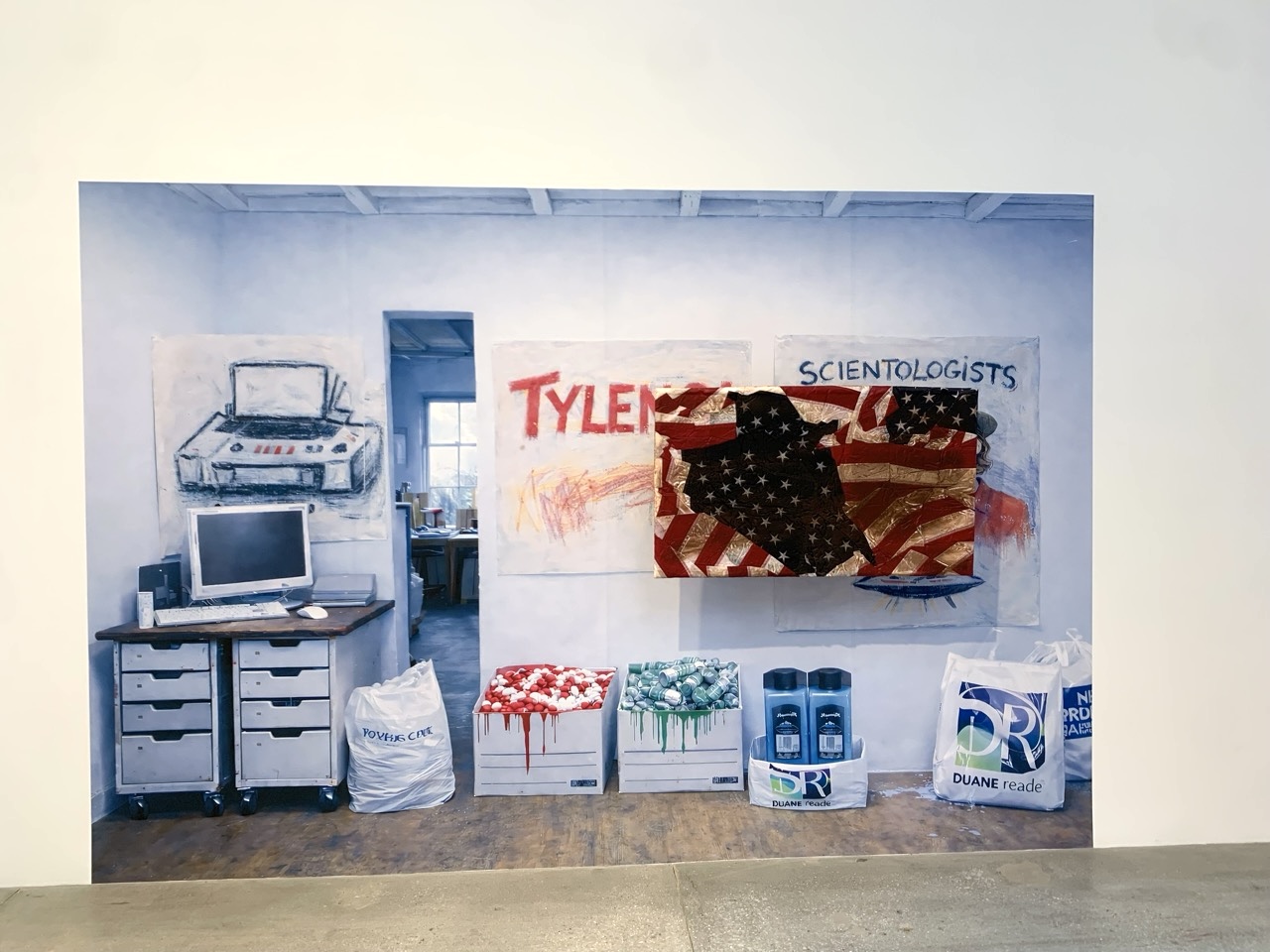
Josh Kline’s studio interpreted by AI, with Josh Kline, Reality Television 9, 2018. Installation view, “Studio Visit” at Hauser & Wirth. Photo by the author.
In February, artists Josh Kline and Anicka Yi organized an exhibition at Hauser & Wirth in SoHo titled “Studio Visit.” On the front wall were several printed-out emails from artists, some as famous as Cecily Brown and Paul McCarthy, each describing a memorable, seminal studio of theirs. In the rest of the gallery, their artworks hung on top of AI-generated mural prints of messy garrets or trim workspaces, prompted using these descriptions. It’s revealing and humanizing to read about Nicole Eisenman’s first, paint-smeared Chinatown flat. And confusing to see an Eisenman painting of a hunched, smoking figure mounted on a picture of the glory days concocted from a slurry of paintbrushes, lofts, bohemias, etc. As a whole, the show reflected a romantic yet barren idea of an artist’s life. It made more sense as a sales ploy.
In fact, the show was a benefit for Performance Space New York, a historic East Village nonprofit. Performance Space is the sort of venue that Kline says New York needs—and is losing—in his somber essay, “New York Real Estate and the Ruin of American Art,” in this spring’s October. Love it or leave it, the piece touched a nerve. Everyone here seems to have read it. The broad strokes, easily inferred from the title, are hard to dispute. Some of the details, like Kline’s insinuation that a Whitney retrospective put him in debt, are sobering. If he’s struggling, as the piece states, to the point of downsizing or closing his studio, then who isn’t?
Kline’s suggestion: move to Philadelphia, or maybe Indonesia. Find somewhere affordable and build a scene there. But many have tried. That’s the problem with Kline’s essay. Nobody disagrees with his diagnosis. The fact that New York is too expensive is bitterly innate for all but a lucky handful. (Heck, a Fox News op-ed recently made the same argument.) That said, the essay’s blind spots are many, and people take them personally. Kline rolls his eyes at painting more than once, and he discounts the precarity of artists born before 1976 (an odd cutoff, also coincidentally the year October started). For that matter, his only note on the travails of art critics is that many of us misunderstood ruangrupa’s documenta fifteen. (I couldn’t afford to go.)
“New York Real Estate” stirs up memories of viral essays from 2024: “It’s Not What the World Needs Right Now,” by Andrew Norman Wilson in The Baffler, and Dean Kissick’s “The Painted Protest” for Harper’s. Each paints a candid picture of contemporary art in shambles. Each has an unsubtle subtext: the eras of art that they mourn and romanticize felt like better times for people like them. He was getting somewhere, then the world changed, and the middle-age art man crashed out.
The author knows how the sausage is made, because he’s made a few sausages himself. He feels the urgency of art’s polycrisis intimately, and he projects his frustration outward, into a critique of the system. For Wilson, the problem is political correctness, which sidelines a straight white male artist like himself; the meager artist fees, sales and residencies sustaining his outwardly enviable but privately harrowing career stop coming. For Kissick, similarly, it’s identity politics, where an artist’s background takes precedence over weird or challenging art of the sort he enjoyed in his twenties, when Hans Ulrich Obrist held court. Kline’s complaint is a little different: he wants artists to embrace class-focused politics, implicitly downgrading identitarian trends while acknowledging that race and class limit access to art’s playgrounds.*
These pieces all resonated for a reason. They point out, and humanize, deep inequities in the economics of contemporary art. At the same time, these observations have the wistful tang of mid-career doldrums. (As a middle-aged art man with an enviable but unsustainable career, I’m especially sensitive to the scent.) Each essay represents a drastic gambit for its author. Wilson, explicitly, wanted out—his gonzo Baffler memoir was a signal flare for a book or movie deal. For Kissick, who had long been making similar arguments for beautiful, disorienting, apolitical art in the industry press, the time was ripe to serve the polite dinner party mumblings of the art world to a bigger, mainstream audience. Kline writes that fewer people are buying risky media like video and sculpture these days, yet his videos and sculptures, including a commercial for universal basic income and 3D-printed sculptures of dismembered proletarians, antagonize the collector class that’s supposed to buy them. It really sounds like he’s leaving town.
Personal stasis and failure are valid prompts for systemic analysis. And the system is failing. But not for everyone, not the same way. The art world of the 2000s and 2010s was buoyed by financial speculation and conspicuous consumption; the scene was clubbier—whiter, maler. Then the general drift of culture turned away from its traditional heroes, and a narrative of (white male) resentment took shape. Regardless of Wilson’s and Kissick’s personal motivations, their essays chimed with that reactionary turn. What these authors mourn, in their ways, isn’t art writ large, it’s Contemporary Art as an art-historical formation. Contemporary Art isn’t characterized by Greenbergian teleology, thank gawd, but by the aimlessness and professionalization of the avant-garde. These essays miss the Contemporary Art that, for all its unnamed washouts, rewarded them with a career. In this month’s New York Magazine, critic Jerry Saltz also wrote of better days: New York in the 1990s, when you could hang out in Tracy Emin’s bed and respectfully ogle Vanessa Beecroft’s nude models. (“I shouldn’t be looking at this, but everyone loves boobs,” Saltz remembers thinking.) His clowning notwithstanding, Saltz (or his editor) has the perspective to frame his halcyon art world as his. People still make and show sexy, fucked up, political art, they even do it in New York, and nostalgia will keep you from noticing.
If nobody’s having any fun, then why are we here? Over the last half century, a set of institutions has expanded to support the modernist idea that self-expression deserves a reward: museums, galleries, magazines, and especially art schools, where a single MFA program mints a gallery roster’s worth of artists every year. Obviously, this is not sustainable. As Kline puts it, we don’t have an art world, we have an art industry. A fickle, risk-averse one. And if artists, being artists, will make work regardless, that becomes an excuse to underpay them. Yet saying your life in the arts doesn’t look like you thought it would, like it used to, like you were promised, is a self-inflicted kind of didacticism. Wilson’s essay is titled, “It’s Not What the World Needs Right Now,” after something a curator said about his work at peak “woke.” I agree with Kline that human beings need art in a general sense, but they don’t need anybody’s artwork in particular.
In the argot of the nonprofit sector, some artists need to consider rightsizing their expectations. If the art industry is so unstable, maybe the trick is to decouple survival from artmaking. One major ill of Contemporary Art is the myth that being an artist lets you transcend regular life. There’s real tension, then, between the romantic idea of the starving but jetsetting artist and the all-too-material scarcity promised by AI mania, billionaire rule, and America First. Kline challenges us to name a famous artist from a working- or middle-class background born after 1975. I’d challenge us to name any professional sector, creative or not, with any reasonable job security. Yes, artists should have food and shelter and healthcare and rewarding work. But not because they’re artists.
_____
| * | Ben Davis cut to the core of this complaint, in 2010: “The position of the professional artist is characteristically middle class in relation to labor: the dream of being an artist is the dream of making a living off the products of one’s own physical or mental labor while being fully able to control and identify with that labor.” See Ben Davis, 9.5 Theses on Art and Class, Haymarket, 2013. |